Your Essential Companion for Jewellery Design and Craft
For any jeweller, whether a seasoned professional meticulously crafting collections or a hobbyist exploring the magic of beads and wire, the creative process is a journey of ideas, materials, and refinements. Yet, so many of those fleeting inspirations, successful experiments, and crucial supplier details are lost to scattered notes and forgotten sketches. This is where a dedicated Jewellery Making Journal Log Book transforms from a simple notebook into a vital studio tool. It is the organised, permanent record of your craft, designed to capture everything from initial concept sketches to final production notes, ensuring your creative and business processes are streamlined, efficient, and consistently improving.
Beyond a Sketchbook: The Core Function of a Craft Journal
While a sketchpad is invaluable, a Jewellery Making Journal Log Book serves a broader, more systematic purpose. It is a structured log designed to document the entire lifecycle of a piece or project. Think of it as the central repository for your design thinking. A typical entry might begin with a mood board or inspiration snippet, followed by several iterative sketches exploring form and proportion. Then, it seamlessly transitions into a materials log: listing specific gemstones, their dimensions and sources, wire gauges, clasp types, and even cost calculations per component.
This integrated approach prevents the common headache of remembering which supplier provided that perfect 2mm freshwater pearl six months later. For professionals, this meticulous record is invaluable for recreating popular pieces or estimating production costs accurately. For learners, it becomes an educational diary, tracking which techniques worked, which solder flows best with certain alloys, and how specific finishing methods affect the final look.
Key Features of a Professional-Grade Journal Interior
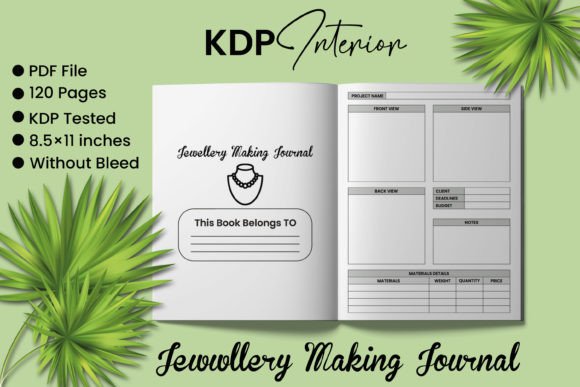
The quality of the journal’s interior layout directly impacts its utility. A well-designed Jewellery Making Journal Log Book KDP interior, such as the one available for instant download, provides a clean, focused framework. Key characteristics include:
- Standard 8.5×11 Inch Format: Offers ample space for detailed sketches and lists without feeling cramped, perfectly sized for binders or standalone use.
- High-Resolution 300DPI Files: Ensures crisp, clear printing for both PDF use and any physical reproduction, guaranteeing that fine lines in templates or decorative elements are sharp.
- Organised Page Structure: An intro page sets the tone, followed by 120 pages of dedicated log templates, typically including sections for project name, date, inspiration, materials list, sketch area, technical notes, cost breakdown, and final observations.
- No-BLEED Interior: This is a crucial technical point for self-publishers; it means the design is safe for standard printing without requiring specialised full-bleed setup, making it ready to upload directly to platforms like Amazon KDP.
The provision of both PDF and JPG files compressed into a ZIP file offers flexibility. The PDF is ideal for direct digital use or printing, while the JPG files can be useful for incorporating specific page designs into other digital tools or promotional materials.
Practical Applications Across the Creative Spectrum
The utility of this journal extends far beyond just recording what was made. Its applications touch on personal organisation, professional business management, and educational growth.
For the solitary artisan, it becomes a personal legacy of skill development. Tracking progress over 120 pages reveals patterns in design evolution and technical mastery. For the small business owner selling online or at craft fairs, the journal is a business asset. Detailed cost logs on each piece ensure pricing is accurate and profitable. Supplier information is consolidated, making reordering efficient. Client-specific modifications for custom orders are documented precisely, improving communication and client satisfaction.
In educational settings, such as a jewellery making class or workshop, a structured journal guides students through a professional design process. It teaches them to think beyond the immediate creation to sourcing, costing, and iteration—skills essential for a sustainable practice. For the digital creator or blogger, the journal’s pages can become source material for content, sharing design journeys with an audience in a structured, engaging way.
Real-World Benefits: Efficiency, Clarity, and Brand Development
Adopting a systematic logging practice yields tangible benefits. Efficiency is dramatically improved. Less time is wasted searching for lost information or re-measuring components. Creative clarity emerges as you visually trace an idea’s evolution, often revealing why one design succeeded while another felt lacking. This reflective practice sharpens your design intuition.
From a branding and professional appearance standpoint, having this organised data at hand allows you to speak confidently about your work. You can share the story of a piece’s creation, the provenance of materials, or the technical challenges overcome. This builds trust and engagement with customers and collaborators. Ultimately, it enhances the entire user experience of your craft, turning a potentially chaotic creative process into a smooth, documented, and rewarding workflow.
Selecting and Implementing Your Jewellery Making Journal
When choosing or using a Jewellery Making Journal Log Book, consider your primary mode of work. If you prefer physical notebooks, ensure the downloadable interior is printed at high quality. If you work digitally, the PDF can be used on a tablet with a stylus for a seamless digital sketch-and-log experience. Evaluate the page structure against your needs. Does it have space for photography notes? Is the materials list section sufficiently detailed?
Implementation is straightforward but requires commitment. Start by dedicating the journal to a single, upcoming project. Fill in every section, even if some feel preliminary. This first complete entry will establish the habit. Over time, you will naturally adapt the template to your unique workflow, perhaps adding colour codes for different project types or custom symbols for technique reminders. The journal should serve you, not constrain you.
The availability of a tested, ready-to-upload KDP interior also presents an opportunity for entrepreneurs in the crafting space. It provides a polished, professional product that can be used for personal practice or potentially incorporated into a broader offering for the jewellery making community. The fact that the files are tested on Amazon KDP ensures a smooth publishing process, removing technical hurdles.
In essence, the Jewellery Making Journal Log Book is more than a product; it is a practice. It champions the idea that jewellery making is a disciplined art form deserving of its own dedicated history. By capturing the whispers of inspiration, the specifics of materials, and the lessons of execution, it empowers creators at every level to build not just beautiful pieces, but a beautiful, organised, and sustainable craft.