A Practical Resource for MUA Documentation: The KDP Makeup Face Charts Template
For makeup artists, whether practicing in a salon, teaching in a classroom, or building a portfolio, consistent client documentation is a cornerstone of professional practice. The challenge often lies not in the artistry itself, but in systematically recording the details of each look—the products, shades, techniques, and client preferences. A specialized tool like the KDP Makeup Face Charts Template addresses this operational need directly, providing a standardized format designed for both practical use and professional presentation.
Core Functionality and Design Intent
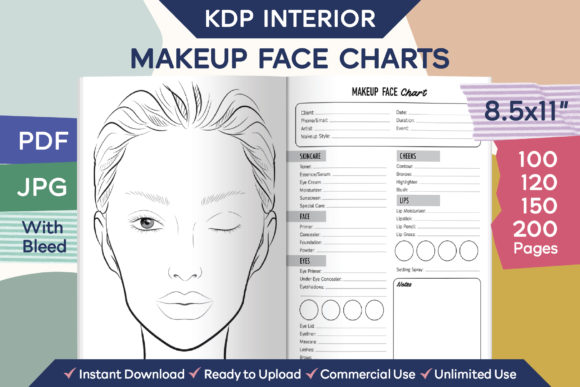
This template is fundamentally a digital interior file formatted specifically for publication via Amazon's Kindle Direct Publishing (KDP) platform. Its primary purpose is to serve as a printable workbook or journal for makeup professionals. The central feature is a repeated layout containing a blank face chart illustration on one page, paired with a detailed, structured form for recording client information and product details on the adjacent page. This bifurcated design separates the visual plan from the textual data, a logical approach that mirrors the workflow of designing a look and then noting the specific components used to execute it.
The inclusion of bleed in the file specifications indicates it is prepared for physical printing, ensuring that if the final printed book is trimmed, no critical content is lost at the edges. This attention to print-ready detail is a sign of its intended use as a tangible tool, not just a digital novelty.
Evaluating Key Characteristics and Practical Value
Several characteristics define this template's utility. The provision of four distinct PDF files, each with a different page count (100, 120, 150, and 200), offers immediate flexibility. A makeup artist who anticipates frequent client sessions might select the 200-page version for a long-term log, while an educator requiring a workbook for a semester-long course might opt for the 120-page variant. This choice allows the user to align the resource's capacity with their projected need, avoiding wasted pages or premature exhaustion of the book.
The standardized page layout is a significant strength. Consistency in documentation is vital for reference and comparison over time. Every chart and data page is uniform, which means a professional can develop a reliable habit of recording information. The structured data section—with designated areas for client details and products used on the face, eyes, lips, cheeks, and skincare—guides the user to capture comprehensive information. This structure prevents incomplete notes and ensures that each entry contains a comparable set of data, valuable for analyzing trends or replicating looks for returning clients.
Presentation and Usability Considerations
The template's design is straightforward and functional. The face chart provides a clear, neutral canvas for sketching color placement and design lines. The accompanying form uses a simple, likely text-based layout, prioritizing legibility and ease of writing over decorative graphics. For a user filling this out by hand post-session, this clarity is crucial. The mention of high-resolution files suggests the line work and any typography in the template are sharp and well-defined, which translates to a clean, professional appearance in the final printed book.
Usability hinges on its integration into a real-world workflow. A makeup artist would likely use this template by printing a bound copy from KDP or using the digital PDFs to print pages locally. After a session, they would sketch the look on the face chart page and meticulously fill in the product details. This ritual not only creates a valuable personal reference library but also elevates client service. Being able to show a client a precisely recorded history of their looks builds trust and demonstrates a high level of professional care.
Identifying the Primary Beneficiaries
This resource is not a generic journal; its value is concentrated for specific users within the beauty industry.
- Working Makeup Artists: Professionals in bridal, editorial, fashion, or salon settings who handle multiple clients regularly. The template offers an organized system to replace ad-hoc notes, improving business operations and client relationship management.
- Makeup Educators and Students: In a teaching environment, consistency is key. Instructors can use this as a required workbook for students to document their practical assignments, ensuring every project is recorded with the same parameters for easy evaluation. Students benefit from building a structured portfolio of their work.
- Product Developers and Cosmetic Consultants: Individuals who need to track product performance and combinations across many applications can use the detailed product logs to gather informal data on shade interactions, wear time, or client reactions.
- Serious Hobbyists and Portfolio Builders: Amateur artists building a portfolio for professional advancement can use the template to create a uniformly presented body of work, which appears more cohesive and professional than a collection of disparate sketches and notes.
For general bloggers or marketers outside the makeup artistry field, this template holds little relevance. Its design is purpose-built for a specific technical task.
Real-World Performance and Long-Term Utility
In daily use, the KDP Makeup Face Charts Template performs as a systematic capture tool. Its effectiveness depends entirely on the user's commitment to consistently filling it out. The template itself removes the friction of designing a log format from scratch, which can be a significant time saver. The long-term value resides in the accumulated volume of documented looks. Over months or years, this becomes a proprietary database of techniques, successful product combinations, and client histories. This can inform future work, serve as a legal record of services provided, or form the backbone of a published portfolio or teaching material.
A possible limitation is its static nature. The template provides a single, fixed layout for data entry. For a makeup artist whose work varies dramatically—perhaps specializing in both minimalist beauty and extreme avant-garde looks—the same face chart and data categories might suffice, but some might desire specialized charts for different face shapes or additional categories for unique products. However, the provided structure is comprehensively foundational for most general makeup artistry practices.
Integration with Professional Goals
Whether this template fits an individual's needs depends on their approach to documentation. A professional who already uses a digital app or custom database to track clients and products may not find a printable paper system advantageous. Conversely, an artist who prefers tactile, hands-on recording, or who operates in environments where digital devices are impractical (like backstage at a show), will find this template highly congruent with their workflow. Furthermore, for those aiming to create a tangible product—selling a makeup log workbook on Amazon KDP, for instance—this template provides a ready-made, tested interior file, significantly accelerating that publishing process.
The KDP Makeup Face Charts Template is a focused tool that solves a clear problem: the need for uniform, detailed documentation in makeup artistry. Its value is practical and operational, deriving from its standardized layout, print-ready formatting, and flexibility in volume. For the right user—a practicing artist, educator, or dedicated student—it represents a straightforward investment in organizing and preserving their creative work and professional data.