From Template to Treasure: Your Composition Book Notebook KDP Interior
You've got a world of ideas, sketches, and plans swirling in your mind. A blank notebook is a promise, but sometimes, staring at that empty first page can feel daunting. What if your notebook was already beautifully structured, ready to organize your creativity from the moment you open it? That’s the practical magic of a Composition Book Notebook KDP Interior. This isn't just a digital file; it's a foundational tool for creators who want to publish or produce professional-looking notebooks with efficiency and style.
Unpacking the Creative Toolkit
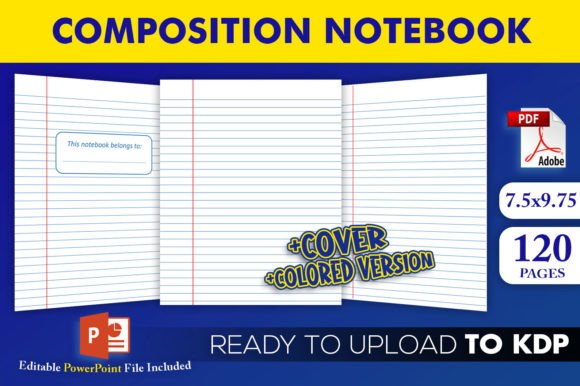
When you download a ready-made interior template, you receive a suite of resources designed to streamline your publishing journey on platforms like Amazon KDP. The package typically includes a tested PDF file formatted to the exact trim size—in this case, 7.5" x 9.75"—with full bleed for a polished, print-ready look. The inclusion of an editable PowerPoint source file is a game-changer. It transforms the template from a static product into a dynamic canvas. You have the power to adjust layouts, change fonts, insert your own graphics, and truly own the design. Add a free cover template, and you have a complete, cohesive project package.
The inherent usefulness lies in its balance of structure and flexibility. The 120-page interior provides a substantial framework, mimicking the classic, trusted feel of a traditional composition book. Yet, the editable source file empowers you to break from tradition. You can tailor it for a specific audience, infuse it with your brand, or adapt it for a completely different purpose than a standard notebook. It saves hours of meticulous formatting and technical setup, allowing you to focus on the creative and strategic aspects of your project.
Beyond the Blank Page: Creative Applications and Variations
Think of the Composition Book Notebook KDP Interior as your base ingredient. Its classic lined pages are versatile, but your creative direction defines the final product. Let’s explore some transformative applications.
For Educators and Workshop Leaders
Turn this interior into a dedicated course workbook or participant guide. Using the editable PPTX file, you can insert section headers, key lesson frameworks, and spaces for exercises directly onto the pages. The consistent layout helps students follow material easily, while the blank lines encourage active note-taking and engagement. You could create variations for different subjects—a sleek, modern interior for a business strategy workshop, or one with subtly decorated margins for a creative writing class.
For Entrepreneurs and Small Business Owners
This template can become the physical companion to your business. Adapt it into a branded client project journal, a meeting notes log with pre-formatted action item sections, or a product development idea book. By customizing the header on each page with your logo or company name in the source file, you create a professional tool that reinforces your brand every time you or a client opens it. The high-resolution, full-bleed finish ensures it looks credible and high-quality.
For Bloggers, Writers, and Content Creators
While the lines invite handwritten content, they can also structure digital planning. Use the notebook as a tangible content calendar, brainstorming space, or series outline. The fixed page count helps you visualize the scope of a project—120 pages could neatly map out a year of monthly blog themes or a complete draft outline for an ebook. The physical act of writing in a well-designed book can unlock creativity differently than a scrolling digital document.
For Hobbyists and Passion Project Creators
The classic composition style is perfect for niche projects. Imagine a specialized gardening planner with custom headers for plant schedules, a travel journal template with edited pages to include prompts for destinations and memories, or a recipe development notebook with areas for ingredients, methods, and tasting notes. The editable source file allows you to add light graphics or icons that resonate with your hobby, making the interior uniquely suited to your passion.
Adapting for Audience and Impact
A key to success is aligning your customized interior with your target reader's needs. A journal for busy marketers might prioritize clean, minimalist lines and ample white space for quick, efficient notes. A notebook for artists or designers, even with lined pages, could be adapted by using the source file to lightly shade alternate rows, creating a subtle graph-like guide for sketches and layouts.
Consider the user experience. The 7.5" x 9.75" trim size is spacious, offering a comfortable writing area. Maintaining a clear, organized layout throughout your edits is crucial. In your PowerPoint file, keep margins consistent, ensure any added text boxes align properly, and use a hierarchy of fonts (perhaps one for page headers, another for prompts) that is easy to read. This attention to detail makes the final product not only beautiful but also genuinely functional.
Practical Steps from Inspiration to Finished Product
Once you have your creative direction, the workflow is straightforward. Begin by downloading and opening the editable PowerPoint (.pptx) source file. This is your design workshop. Start simple: perhaps just change the font on the header to one that matches your cover design. Then, consider if you need to add any persistent elements.
- Could the bottom corner of each page feature a small inspirational quote related to your topic?
- Should pages 10, 20, and 30 be designed as special checkpoint pages with summary prompts?
- Would a light watermark or a subtle page number design enhance the professional feel?
After your edits, save the PowerPoint file, then export or generate a high-resolution PDF ensuring it meets KDP’s specifications (the provided ready PDF is your reference). Use the included cover template to create a visually matching cover. The result is a cohesive, original notebook that feels custom-made, not generic.
Keeping Your Results Original and Effective
The goal is to use the template as a launchpad, not a limitation. Avoid simply uploading the stock PDF as-is if you want to stand out. Your customization adds value. For authenticity, infuse elements from your own knowledge or niche. If you’re creating a wellness journal, perhaps your introductory page in the source file can include a unique grounding exercise you personally use. This builds E-E-A-T (Experience, Expertise, Authoritativeness, Trustworthiness) into the product itself.
Finally, test the user journey. Print a sample page or view the PDF on multiple devices to check readability. Is the line spacing comfortable? Are any added elements distracting from the primary purpose—writing? The template provides the tested technical foundation; your creative input provides the soul and specificity. By merging the two, you transform a Composition Book Notebook KDP Interior from a useful download into a powerful tool for your audience, and a streamlined publishing achievement for you.