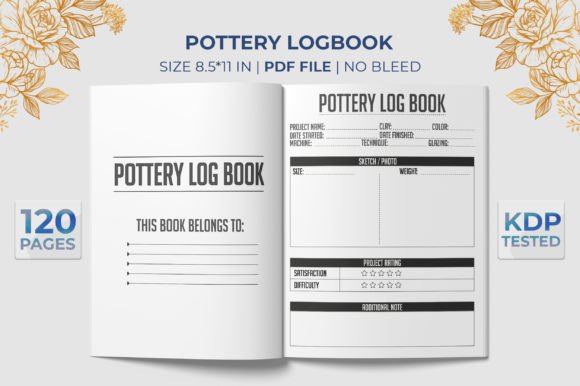
The Pottery Logbook: More Than Just a Record Book
For anyone who has felt clay under their fingertips, the process is both art and science. It’s a dance of moisture, pressure, and time. The Pottery Logbook transforms this tactile experience into a structured, yet deeply personal, journey. It’s not merely a notebook for scribbling glaze recipes. It becomes a central hub for your ceramic practice, a place where experimentation meets documentation, and intuition is supported by data.
From Studio Hobbyist to Professional Potter: Universal Applications
Imagine you’re in your studio, having just pulled a stunning vase from the kiln. The glaze has reacted in a way you’ve never seen before—a beautiful, mottled effect. A week later, you desperately try to recreate it, but the details are fuzzy. Was it a slightly thicker application? Did you change the firing temperature? The Pottery Logbook solves this. By dedicating space for detailed entries on clay body, glaze mix, application method, firing schedule, and results, it turns accidental successes into reproducible techniques.
The Classroom and Community Studio Companion
In a learning environment, whether you’re a teacher guiding students or a participant in a community workshop, consistency is key. The logbook provides a uniform framework for students to track their progress across multiple projects. This is invaluable for seeing improvement over time, understanding the consequences of different techniques, and building a portfolio of work that includes the process behind each piece. For teachers, it offers a structured way to review student work and provide targeted feedback based on recorded choices.
Furthermore, in a shared studio space where many artists use communal kilns, having a clear, written record of your firing requirements—cone temperature, special ventilation needs, precise placement—is essential for both your work’s success and the safety of others’ pieces. The Pottery Logbook acts as a clear communication tool between you and the kiln master.
Specialized Scenarios Where a Logbook Becomes Essential
Beyond general studio use, specific pottery paths find incredible utility in a dedicated logbook.
The Glaze Alchemist’s Laboratory
For potters deep into glaze chemistry, the logbook is their primary research document. Each page can track a test tile: the precise percentages of each material, the source of the silica or feldspar, the milling time, the application thickness, and the visual result after firing. Over time, this builds a proprietary database of effects. You can cross-reference pages to see how varying one ingredient by 2% impacts color saturation or texture, moving from guesswork to methodical innovation.
The Production Potter’s Business Tool
If you create lines of work for sale—like a signature set of dinnerware—the logbook shifts from a creative tool to a production one. You can document the exact, optimized process for each item: the weight of clay needed, the throwing time, the specific drying stages to prevent warping, the glaze batch number used. This ensures every piece in a collection is consistent, which is the bedrock of customer trust and brand integrity. It also helps in calculating true material costs and time investment per item, which is critical for pricing your work accurately.
The Therapeutic and Meditative Practice
Pottery is often pursued for its mindful, grounding qualities. For these practitioners, the logbook can serve a different purpose. It might focus less on chemical formulas and more on personal reflections. What was your state of mind when you centered that particular lump of clay? How did the rhythmic, repetitive motion of trimming affect your anxiety that day? Recording these experiences creates a link between the physical act of making and the emotional or psychological journey, enriching the craft’s healing power.
Practical Considerations Before Choosing Your Logbook
While the concept is universally beneficial, the physical design of the logbook matters. The ready-to-use Pottery Logbook with 120 pages, formatted for 8.5”x11”, presents specific advantages and considerations.
Its size offers ample space for detailed notes, sketches of forms, or even attaching small photo printouts of results. The no-bleed, clean PDF format means it’s perfectly suited for printing at home or through a professional service if you prefer a tangible, bound book to keep on your studio shelf. The high-resolution ensures any templates or diagrams within are crisp.
However, consider your own workflow. Do you prefer digital tracking? A printed logbook is a commitment to analog process. Its strength is in its permanence and tactile nature—it lives in your studio, not on a screen. It also requires the discipline to consistently fill it out. The best practice is to make entries immediately after an action—right after mixing a glaze, right after unloading the kiln—when details are fresh.
Adapting the Logbook to Your Unique Needs
The standardized interior is a framework, not a constraint. A production potter might use the pages primarily for batch records and quality control checks. An artist exploring sculptural forms might use the space for drawing successive sketches of a piece’s evolution. The key is to see the logbook as your own. You can add columns, create symbols for quick notations, or use certain sections exclusively for tracking kiln maintenance schedules. Its value is amplified by how personally you adapt it.
Beyond Pottery: The Logbook Philosophy for Other Disciplines
The core principle of the Pottery Logbook—methodical tracking of process to improve outcomes—is transferable. This is why the same structured, 120-page logbook format is also offered as a Badminton Training Logbook. The parallels are clear. An athlete tracks training drills, match performance, physical condition, and equipment just as a potter tracks clay, glaze, firing, and results. The goal is identical: to move from vague feeling to clear analysis, from sporadic progress to steady improvement.
Whether your craft is shaping clay or perfecting a smash, the act of logging forces observation, reflection, and planning. It turns practice into a dialogue with yourself, where each session informs the next. This makes the logbook not just a product, but a partner in your growth, for any skill where the journey is as important as the finished piece.